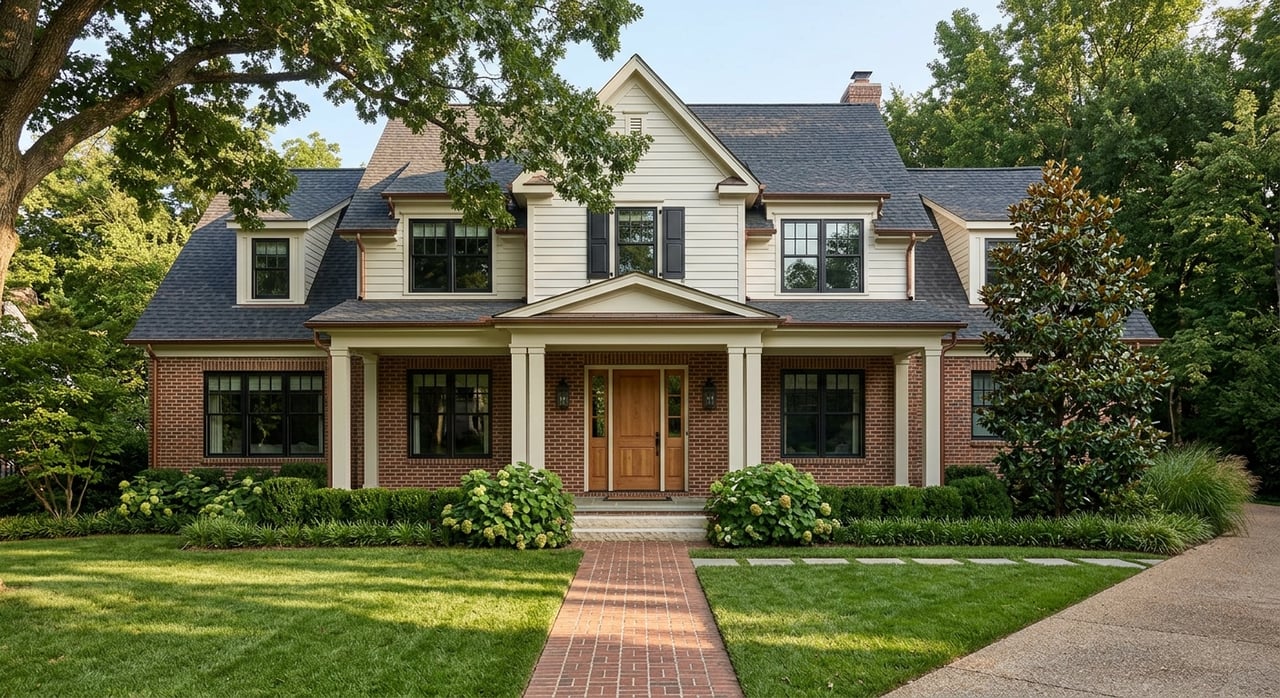
Franklin vs Brentwood Homes: How to Choose the Right Fit
June 4, 2026
June 4, 2026
Trying to choose between Franklin and Brentwood? You are not alone. These two Williamson County cities attract many of the same buyers, but they live a little differently day to day. If you are weighing budget, home style, commute, and overall feel, a side-by-side look can make the decision much clearer. Let’s dive in.
Franklin and Brentwood are both about 42 square miles, but they differ in scale, price point, and development pattern. Franklin’s 2025 population estimate is 90,226, while Brentwood’s is 45,313. That means Franklin feels like the larger and more active city overall.
The cost gap is one of the first things many buyers notice. Census data shows Franklin’s median owner-occupied home value at $705,400 compared with $1,031,300 in Brentwood. Current home value estimates point in the same direction, with Franklin at $893,851 and Brentwood at $1,398,755.
Household income also reflects that difference. Franklin’s median household income is $119,528, while Brentwood’s is $182,088. In practical terms, Brentwood usually asks for a higher entry budget.
Franklin is known for blending historic character with modern growth. City materials highlight a 15-block historic downtown, annual festivals and parades, Cool Springs as a business, dining, and shopping hub, and an east-side commercial area with retail, a regional mall, and corporate offices.
If you like the idea of living in a place with visible history and multiple activity centers, Franklin often stands out. It can feel more layered and active, with older areas, commercial hubs, and preserved historic spaces all contributing to daily life.
Brentwood presents itself a bit differently. The city emphasizes rolling hills, parks and greenways, and a strong retail and restaurant scene, while also noting that about 90% of its zoning is residential.
That tends to create a more consistently suburban feel. Compared with Franklin, Brentwood often reads as quieter, lower-density, and more centered on residential living patterns.
Franklin is denser than Brentwood. Census figures show Franklin at 1,952 people per square mile, while Brentwood is at 1,103.7 people per square mile.
That difference matters if you are thinking about pace and privacy. Franklin may offer more activity and proximity in many areas, while Brentwood often appeals to buyers looking for more breathing room between homes and a lower-density setting.
Owner occupancy also points to a different housing profile. Franklin’s owner-occupied rate is 63.8%, while Brentwood’s is 90.4%, reinforcing Brentwood’s identity as a predominantly owner-occupied residential community.
If home character is high on your list, Franklin offers more architectural range. Its historic districts include homes from the 1820s through the mid-20th century, with styles such as Federal, Greek Revival, Italianate, Queen Anne, Colonial Revival, and Craftsman.
That variety can be especially appealing if you want an older home, a traditional streetscape, or a stronger sense of place. Franklin’s design guidelines also emphasize preserving open and rural character in certain areas, especially around Harlinsdale.
Brentwood’s zoning framework tells a different story. The city includes agricultural-residential lots of at least 3 acres, residential districts with 2-acre and 1-acre minimums, and open-space residential development organized around one dwelling unit per acre with preserved open space.
In simple terms, Brentwood tends to align with buyers who want larger lots, estate-style settings, and a more uniform suburban pattern. If space around the home is a top priority, Brentwood may feel like the stronger fit.
Purchase price is only part of your monthly picture. Franklin’s median monthly owner cost with a mortgage is $2,542, compared with $3,406 in Brentwood.
The rental market shows a similar spread. Franklin’s median gross rent is $1,923, while Brentwood’s is $2,825. Even if you are buying, these numbers help show how the two markets are positioned overall.
Property taxes are another factor worth reviewing closely. Franklin’s total city and county burden is about $2.06 per $100 of assessed value once the Franklin city levy is added. Brentwood’s combined city and county burden is about $1.49 per $100 assessed value.
That does not automatically make one city cheaper overall, since home values differ so much, but it does affect your long-term carrying costs. Looking at both home price and tax structure together will give you a more realistic monthly budget.
Franklin’s park identity ties closely to both open land and local history. Harlinsdale Farm spans 200 acres and includes a 5K soft track, dog park, pond, and equestrian trail. Eastern Flank Battlefield Park adds 110 acres of walking space and interpreted historic trails.
The city’s greenway plan also frames trails as a way to connect parks and public rights-of-way across Franklin. If you enjoy places that combine recreation with historic context, Franklin offers a distinctive mix.
Brentwood’s park system totals 1,027 acres across 14 parks. The city also highlights trail guides and greenways, with a strong focus on recreation woven into daily residential life.
If easy access to neighborhood-oriented parks and trails is important to you, Brentwood has a strong case. The scale of the park system is a major part of the city’s appeal.
Franklin and Brentwood differ in how students move through public schools. Franklin has the Franklin Special District, established in 1906, which serves pre-K through 8 in eight schools. Students then move into Williamson County high schools, often Franklin High or Centennial depending on zone.
Brentwood follows Williamson County Schools directly. Brentwood Middle feeds Brentwood High, which serves about 1,750 students.
For many buyers, this is less about ranking schools and more about understanding district structure. If grade configuration and school transitions matter in your planning, this is an important difference to review early in your home search.
Franklin’s city site places it 20 miles south of Nashville. Brentwood describes itself as a suburb of Nashville, which generally makes it the closer-in option for many central Nashville commutes.
That said, your real commute depends on your neighborhood, work destination, and travel times. A home in one part of Franklin could work better for you than a home in another part of Brentwood, depending on where you need to go most often.
There is no one-size-fits-all winner here. Franklin and Brentwood are both strong options, but they serve different priorities. Franklin tends to offer more historic identity, architectural variety, and mixed-use energy, while Brentwood tends to offer larger-lot suburban living, lower density, and a higher-end price tier.
The right move starts with how you want to live, not just where you think you should buy. If you want tailored guidance on neighborhoods, pricing, and the right fit for your next move in Williamson County, Redbird Real Estate is here to help.
Stay up to date on the latest real estate trends.
We pride ourselves in providing personalized solutions that bring our clients closer to their dream properties and enhance their long-term wealth. Contact us today to learn how we can assist you.
By submitting this contact module, you agree to be contacted by Redbird Real Estate, and it's affiliates, via call, email, and text for real estate services. To opt out, you can reply 'stop' at any time or reply 'help' for assistance. You can also click the unsubscribe link in the emails. Message and data rates may apply. Message frequency may vary. Link to Privacy Policy.
135 5th Ave S., Suite 100 Franklin, TN 37064